My mother, although multi-talented, had an aversion to the kitchen and has often said that I learned to cook at an early age “out of self-defense.” When she made chicken à l'orange by smearing a chicken with powdered Tang, I quickly developed a necessary passion for creating tasty things to eat. Somewhere in the family photograph album is a picture of me at the stove, age ten, happily stirring marinara sauce.

I developed a lifelong fascination with food; good food. There was even a foray of working as a chef’s assistant at a French restaurant during my mid twenties, just for fun. I had always loved watching Julia Child and knew that Mastering the Art of French Cooking was to be revered. It wasn’t until I read her biography (long before the Julie & Julia movie) that I really became fascinated with her work. From that book, I decided to prepare her recipe for mayonnaise.

Upon tasting it, I wept. . . .


Search This Blog

Showing posts with label Bavarian Cream. Show all posts

Sunday, February 26, 2012

Mastering the Joy of Julia

Having prepared a multitude of recipes from Mastering the Art of French Cooking, I finally decided to tackle the notorious Pâté de Canard en Croûte -- the boned, stuffed duck in pastry that seemed so frighteningly daunting to Julie Powell in the film, Julie and Julia

However, a pâté, no matter how extravagant or daunting, just didn’t seem like it could be the main feature of a meal. I decided to go “over the top” with an all-out Julia extravaganza for this event. After all, Julia always advised, "everything in moderation -- including moderation." So, in the vein of obligatory immoderation, one recipe from Mastering just wouldn’t do; I went for seven.

“Over the top” meant that the famous Pâté de Canard en Croûte would be the appetizer. 

Fortunately, I prepared the pastry the night before. The steps in preparing the pâté seemed to be a never-ending story. Of course, we all know about the “boning of the duck,” so here it is from start to finish. (Many thanks to my friend, Steve, for the video production. The music was performed and recorded by yours truly.)
Vegetarians may want to look away at this point:


Let me just say that ducks are very well-constructed little beasts; much more so than their chicken cousins.

Monsieur duck was now de-boned and ready for the veal and pork pâté -- oh, and it's a pâté that also contains truffles, although Julia writes that they are an “optional extravagance.” Since I was going all-out, I had a jar containing two truffles at hand -- extravagant, indeed. 

Once the pâté was placed inside, it was time to stitch it up. However, my makeshift trussing needle kept catching on the skin of the duck and was in danger of tearing it. It was then that my friend, Steve, gently reminded me that he was quite adept at suturing animals; after all, he is a veterinarian for crying out loud. I happily handed the task at hand over to him. (Hint: Preparation of Pâté de Canard en Croûte requires an actual trussing needle – that, or a veterinarian on standby). 

Armed with a pair of pliers and my makeshift needle, Steve expertly went to work. 


“Someday I’ll get you down to the clinic and have you stitch up a cat,” he said without looking up. 

After the duck was professionally sutured, I was able to truss it using butcher’s knots. Julia didn’t mention that it would resemble a giant larva. 


It was at that precise moment that I realized I had forgotten to include my extravagant truffles! 

Mistakes happen in the kitchen. They certainly happened to Julia and on PBS television to boot. But my truffles? 

“No apologies,” as Julia had often said. I realized this could be a happy mistake. As much as truffles cost, they might as well be noticed rather than diced up in the pâté. I would simply feature a slice or two on each serving later on. Prominently.   

The giant larva was browned, cooled, en-croûted, decorated, and egg-washed.


After baking and letting it cool, here’s a proud guy with his Mastering masterpiece. 


Another friend arrived a couple of hours before the meal. She’s an excellent cook and I was only too happy to have an extra pair of hands on hand. I’m fine with preparing a meal, but last-minute sauces, plating up, and I tend to cower under a table. 

My friend, Steve the veterinarian, also sets a lovely table and for that, I am eternally grateful. 


The meal for eight began with an amuse-bouche of small toasts topped with horseradish sour cream and black caviar accompanied by tiny shots of icy-cold Stolichnaya vodka – a very happy and effective way of amusing the bouches of one’s guests I might add. 


It was time for the pâté. Since the duck-encased pâté is baked in its pastry sarcophagus while trussed, one must de-truss it before serving. Julia instructs us to cut the top of the pastry off, retrieve the trussed pâté, remove the strings, return the pâté to the pastry, return the top of the pastry to its place, present it to the guests and slice it at the table. 

All I have to say is, "Rub a lamp, Julia."

The pâté and the bottom of the pastry had fused and become one. There was no removing of the pâté without destroying the pastry. Guests were waiting. 

The pâté was removed, sliced, adorned with awaiting truffles and served with a dry Italian sparkling red – sans croûte.

 
After all, the pâté itself was a slice of juicy, porky, ducky heaven. The croute would have been a pasty afterthought.  Again – no apologies.

Next, Soupe à l’oignon. No gratinée or crouton included; just the luscious, oniony soup served along with a dry California chardonnay (2010 Bin 36 Monterey Chardonnay.)

Main event: Sauté de Boeuf à la Parisienne -- beef filet with mushrooms in a port and cream sauce. It’s one of my favorite entrees of Julia’s and, surprisingly, relatively quick and easy to prepare (Nigella Lawson, take note). Served with asparagus with beurre blanc, pommes de terre Parisienne, petit choux au fromage, it was a meal that pretty well epitomized what our Julia was all about. 


 A 2009 Domaine Chêne Bourgogne Pinot Noir was luxurious and just acidic enough to stand up to the cream and butter sauces.

Bavarois Praliné (almond praline Bavarian cream) is my go-to dessert, as much of it can be prepared the day before. 


With all the requisite steps (toasting almonds, making a caramel, beating egg whites, whipping cream, preparing a custard and a Crème Anglaise), one really should prepare it the day before. Trust me. 

Why not end such a meal with a dessert containing twelve egg yolks? Remember, obligatory immoderation.

Sortilège is a maple syrup and whiskey liqueur that has been produced by our Canadian friends for over 300 years and is a favorite of mine that is always kept on hand. It never ceases to invoke ooohs and aaahs from every guest, so of course, it accompanied the Bavarian cream. The expected ooohs and aaahs ensued.  

Laughter among friends poured into the night. My feet and back were sore from day’s preparation, but it’s a small price to pay; the payoff of sharing such a meal with friends one loves is priceless. 

 True, I knew how to cook before encountering Julia Child. However, I’m still happily learning to Master the Joy of Julia. 


Saturday, June 5, 2010

Deux Bavarois aux Pralines

Two Bavarian Creams Flavored With Almond Pralines.

My last post espoused the glories of Julia's Bavarian Cream with Almond Praline. I have to tell you that this dessert was such a hit that it's been commissioned to make a double-appearance at a gathering for approximately forty guests in a couple of days.

I must also tell you that the host of this gathering is another Julia fan and friend of mine who actually met her during a cooking class in San Francisco during the early 90s.

I'm looking forward to presenting this dessert, but feel that I must document such an endeavor.

Now that you know how astounding this dessert is, hopefully, you'll be soon doing the same for dozens of your friends as well.I've seen lots of other bloggers giving measurements to Julia's recipes here and there. I've yet to hear of any litigious pursuits over such endeavors, so I'll tentatively do the same.

For two almond pralines, I find it best to begin with a 2-cup package (16 oz) of slivered almonds and toast those. The recipe for each calls for 1/2 cup of pulverized almond praline plus 2 Tbs of pulverized praline for the topping. You might as well toast twice as much as you need and freeze the rest. Or, if your almonds or caramel don't appear to be really toasty, freely double the amount.

I've learned that excessive almond praline in this recipe can seldom be a bad thing.Having prepared this dessert so often and studied J. Child pedagogy, I feel confident that she would agree. Just as with performing a Bach Fugue, liberties may be taken, but only with hands full of knowledge and respect.

Here is what two cups of toasted almonds look like after having been submitted to three minutes at 350, stirred, then two more minutes.
The extra toasty bits on the side would taste awfully burnt if they'd gone 30 seconds more. This is when you want to stop and mix the toasted almonds in. Any more, and you will have wasted five bucks worth of nuts.

Here are two cups of sugar and 1/4 cup of water, very gently swirled, and bubbled away to make a caramel. This is the point where the toasted almonds should be quickly stirred in, and very quickly and poured out onto a greased baking sheet.

I'm toying with the idea of using toasted Macadamia nuts instead of almonds. They weren't available to Julia back in the 1950s like they are now. Macadamia nuts can hardly be considered a "French" food item either, and now that I think about it, I'm not so sure we should be heading off into Nigella Lawson territory, scrumptious though she is.

Let's stay with what's known and relish it.Now that the recipe is doubled, here we have the requisite fourteen egg yolks, ten egg whites and the remaining four egg whites.


In olden days, I'd be saving the four remaining egg whites, pouring them into a plastic Ziploc bag, collecting them, and freezing them for later use.

But let's be honest here. Julia's recipes call for a huge amount of egg yolks compared to egg whites. Saving the whites, while may be admirable, is hardly practical and a messy ordeal. Unless you have an inordinate desire for egg-white omelets, dump the remaining whites down the Dispose-All.

Next is the making of an egg custard. In this case, the fourteen yolks are beaten with two cups of sugar in the mixer until frothy, lemon-colored, and ribbony.

Meanwhile, three cups of milk (full-fat only, please) is heated in a large sauce pan until boiling, then added in driblets to the egg yolks. That mixture is returned to the sauce pan and heated to make a custard.

As I've said before, custard can be a tricky thing. When I thought I knew Everything-You-Always-Wanted-to-Know-About-Custard, my custard surprised me and broke, resulting in a grainy mess of hard-scrambled eggs and whey.

Oh well. Life is often like that. Just when you think you know everything, your work results in curds and whey. Learn from it, laugh at yourself, be sure to pass on the lessons, wash the dishes, and head on.

So, here are some helpful custard hints for you that I hope will make your life easier:

Use a rather large sauce pan or pot. You'll want a large enough pot to enable some rather vigorous stirring with a rubber spatula -- and you'll want to be able to "feel"the bottom of the sauce pan for any scratchiness. Such would signify that the egg yolks are cooking too fast and scrambling. A small sauce pan would inhibit your free movement of the spatula.

Regarding the proper heat source: Something that is hot enough to cook the egg mixture without scrambling them is best.

Fortunately (or unfortunately) I am stuck with the original 1964 General Electric, push-button stove that came with my apartment, in Harvest Gold to boot.

The large, front burner only works on "high" and nothing else. Therefore, I've grown quite comfortable with moving the egg custard pot back-and-forth from the large, full-bore burner to the smaller burner set on medium. That way, I'm able to gauge exactly what the heat is doing to my custard.

While this may seem cumbersome, I'm reminded of my paternal grandmother in Texas who preferred preparing the family meals on her wood-burning stove in the ranch house even though a gas stove had long been supplied. Obviously, she had developed an extremely keen heat-source intuition that served her very well. My old-fashioned, GE push-button clunker does the same for me.

So, here is what a double-recipe of egg custard should look like when you stir it.

Again, the moment you feel any scratchiness on the bottom of the pot when you're stirring it with the rubber spatula, move it away from the burner and all will be well. Once you get used to the proper heat source, this should take no longer than 8-10 minutes on the burner(s).

Set the custard aside and prepare the coffee-gelatin mixture. One cup of really strong coffee should be on hand with four Tbs of gelatin. When you think about it, it's never a bad idea to have a large cup of your best, really bold Italian roast on hand for the cook either. The extra cup, actually, should be an after-thought.

Whip the ten egg whites (pinch of salt, spoonful of sugar) to medium peaks. Not limpy whites, but not firm screaming peaks either. Just regular egg whites.
You know.

Fold them into the custard in The Usual Manner: 1/3 mixed in to lighten the batter, the next two-thirds in the folding manner; cut the whites in with a J formation, turning the bowl, so as not to deflate them.
Next, whip one cup of heavy cream. (Please -- there's never any need to dirty another measuring cup with buttery cream if your cream came in a 16-oz container).

Do the math. Dump half of it in.
Whip the gelatin together with the hot, delicious coffee that should always be on hand for the cook.
Fold in the ground praline, (be sure to save about 1/l4 cup for the toppings later) the whipped cream, the gelatinized coffee all together. Use your best folding technique so that the final result will "have a most lively, light, creamy, velvety quality," as Julia puts it.

Divide the custard into two 9-inch containers lined with Saran Wrap (cling-film).

I use one 9-inch springform cake pan and one 9-inch Tupperware container because that's what I happen to have on hand. Be sure to line the bottom of each with plenty of plastic wrap, more than you think you'll need, as it's all pretty unwieldy.


Fold the plastic wrap over the top and refrigerate it overnight or at least eight hours.

Meanwhile -- and I hate to tell you this -- but you'll need to get your custard-making tool-belt back on. You'll be making it again as a topping and side-sauce, but please, make it at your leisure. It won't be needed until you serve it and it can be refrigerated until needed. (Whew!)

Un-mold the custard onto a serving platter, pour half the custard on top along with the remaining praline. Serve the remaining custard on the side.

Again, words cannot express how pleasurable this dessert is.


To me, there really is something supernatural about her endeavor that she left behind.

And that's what I love so much about the work that our Julia provided for us all.

Tuesday, June 1, 2010

Bavarois aux Praline

Almond Praline Bavarian Cream

I think I'm in love.
Pure, head-over-heels, Ali-McGraw-in-Love Story in love

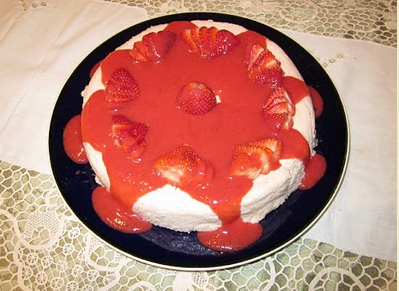
I recently made Julia's Bavarois aux Fruit which is a Bavarian Cream flavored with fresh strawberries and it was incredible. It was one of those desserts where everyone sort of has this stunned look on their faces upon taking the first bite; it's that good.
Here's a photo:


As with most recipes in Mastering, there's a main recipe and then several variations. The strawberry Bavarois was so luxurious and impressive, I decided to try the variation flavored with an almond praline.

Holy-Mother-of-God, I didn't think it was possible, but it was even better. Seriously, this is one of those recipes you must have in your culinary repertoire. After you're long gone, your great-nieces-and-nephews will sit around the Thanksgiving table with their grandchildren and they'll all reminisce about your Almond Praline Bavarian Cream.

It's that good.

Yes, this recipe sounds pretty involved and there are a number of steps to it. But aren't all legendary feats worth the effort? Besides -- and trust me on this one -- once you've made it a couple of times it won't seem nearly as intimidating. You'll be whipping out Bavarian creams with insouciance; with careless ease.

First, there's the almond praline which I've told you about here. Yes, there's carmelized sugar involved along with toasting slivered almonds. If that seems too daunting of a beginning, make it the day before and be done with it.

The almond praline is ground in the food processor and you're on to the Bavarian cream. A custard is made with seven egg yolks, sugar, hot milk, and flavored with vanilla. To set up this molded dessert, gelatin is dissolved in a half cup of strong coffee. (The coffee gives it another layer of flavor that really doesn't say "coffee", but rather, just another dimension that makes this dessert so appealing.)

If you're making this dessert all in one go, now would be the time to tackle the almond praline while the hot custard is cooling.

Five egg whites are whipped and folded into the custard. Then, fresh whipped cream is folded in along with the coffee/gelatin and the crushed almond praline.

The whole thing sets up in the fridge -- I use a 9-inch springform cake tin lined with plastic wrap.

Julia did always say, "Everything in moderation; including moderation."

So, in the vein of obligatory immoderation, another batch of custard is prepared as the topping. Yes, there are, indeed, fourteen egg yolks in this recipe and that's what your ancestors will be remarking about after you've left this good Earth.

The dessert is unmolded onto a serving platter, about half the custard is swathed on top along with the remaining praline. Serve the remaining custard on the side.


Trust me, this is food from the angels. You need to make this dessert.

Now.

I mean it. . . . Go.

Tuesday, May 18, 2010

Bavarois aux Fruits

For some strange reason, I’ve never really been “into” desserts or have enjoyed sweets for that matter. The idea of enjoying a full meal and then being presented with a sweet food item almost seems bothersome to me. Even chocolate is way down on the list of things I like to eat.

That’s not to say I’ll pass up cheesecake or a slice of coconut cream pie. I just don’t want it at the end of a meal -- a good cup of coffee will do fine, thank you.

About a month ago, I was preparing a full-on Julia meal for eight. I knew that my friend, Steve, really enjoyed desserts – a lot. He’s Swedish so I think a love of sweets is embedded in his DNA.

With that in mind, I wanted to prepare something really special and appealing for dessert. Although I had yet to peruse the dessert section of Mastering, I felt pretty certain that Julia would have some incredible desserts there.

She did. Big time.

We might think of Bavarian cream as the squishy inside of cream doughnuts. Nope. A real Bavarian Cream is a molded dessert in which custard is thickened with gelatin, flavored, and lightened with whipped cream and beaten egg whites. Uncharacteristically for Julia, she really lays on the accolades:

“When properly made, it has a most lovely, light, creamy, velvety quality and ranks as one of the best of the molded desserts.”

If Julia says that about a dessert, then my dessert-loving friend deserved it.

Begin with 7 egg yolks. (Always an encouraging start if you ask me.) Those get beaten with sugar until pale yellow and ribboney. Hot milk is added and it gets simmered until a custard results.

Custard can be a tricky thing and is normally made over a double-boiler to prevent the eggs from over-cooking, resulting in scrambled eggs. Julia instructs us to simmer it directly over moderate heat. That can be done if you’re careful. Be brave, but keep stirring with a watchful eye, and don’t you dare leave the stove. I definitely like to use a rubber spatula to stir it with so that there’s no chance of egg scrambling on the bottom of the pan. If it begins to thicken really quickly or seems too hot (too “steamy”), remove it from the heat and stir rapidly. A nearby ice-bath in which to quickly cool it might be a good idea, but I like to live on the edge and didn’t have one.

Her main recipe is for an orange Bavarian cream but the variation, Bavarois aux Fruits, indicated that one could flavor it with strawberries or raspberries. Since it was spring and strawberries seemed to be everywhere at the markets, I went with that.

When using strawberries, one must puree the berries and strain out the seeds. Normally, I’m not a big fan of straining sauces excessively but it this case, the tiny seeds would have really been intrusive. (I tasted it with the seeds in.) Remember, Julia said it was velvety and so toward the velvety direction I did head.

Gelatin is dissolved into a cup of the strawberry sauce and that is whisked into the custard (which is actually Crème Anglaise). Meanwhile, egg whites are whipped and folded in. Then heavy cream is whipped, flavored with kirsch, and that also is folded in.

It gets molded into a 9-inch springform pan (which I lined with plastic wrap for easy removal) and refrigerated.

Serve with the strawberry sauce and decorate with fresh berries.

Upon taking the first bite, I could see why Julia praised this dessert so much. In my opinion, she wasn’t excessive enough with the enthusiastic acclamations.

This stuff is to be worshipped.